
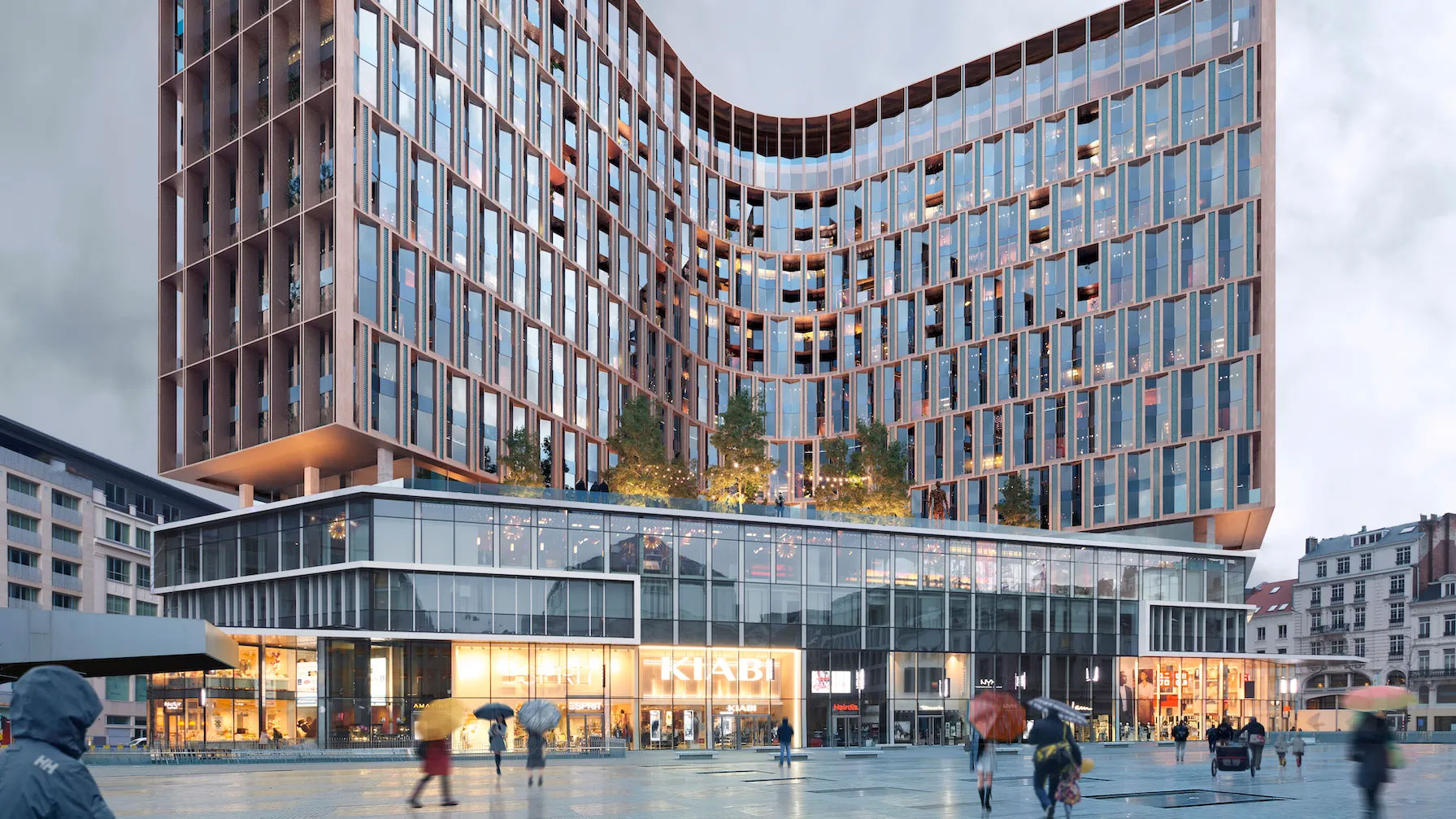
Whitewood’s urban ambition
Building value through strategy, impact and integrity
In an exclusive conversation for CEUSTERS Magazine, Frédéric Van der Planken, founder and CEO of Whitewood, provides an in-depth look at the firm’s evolution, philosophy, and ambition. What emerges is the portrait of a real estate company that does far more than develop buildings — it develops vision. By aligning strategy with impact, and finance with social value, Whitewood is reshaping not just the Brussels skyline but also the way the industry thinks about long-term value.
From buildings to strategy: The origins of Whitewood’s model
Founded in 2008, Whitewood did not begin as a traditional developer or broker. Instead, the company focused on serving institutional capital and solving problems at the level of buildings. “We started with property management,” Van der Planken explains, “not to make a margin, but to build trust and control over the asset.” Property management was never the endgame—it was the first brick in a more ambitious structure.

Over time, this evolved into full-fledged asset management and ultimately, project development. “Whitewood 2.0” launched in 2014, as the company turned away from opportunistic post-crisis plays to long-term urban transformation projects. “We wanted to do large, complex, inner-city projects with real impact,” he recalls. At the core of this approach is vertical integration: a full-spectrum control of the value chain, from property acquisition and development to asset, project, and fund management. Unlike many of its peers, Whitewood does not rely solely on real estate talent. The team includes professionals from private equity, corporate finance, and infrastructure—people who understand structure, capital, and execution. “You can learn real estate,” Van der Planken says, “but strategy and finance is something else.”
Rethinking real estate brokerage
This strategic mindset also shapes how Whitewood looks at the brokerage industry. Rather than viewing brokers as mere deal facilitators, Frédéric Van der Planken sees the potential for them to evolve into true strategic partners. While he acknowledges that the traditional commission-driven model often lacks speed and differentiation, he believes the real opportunity lies in a more consultative, value-driven approach.
Brokers, he argues, can deliver far greater impact by deeply understanding their client’s business—how workspace ties into talent attraction, culture, and long-term strategy. “It’s not just about square meters anymore,” he notes, “but about how space supports recruitment, retention, and identity.”
For Van der Planken, real estate knowledge can be learned; what sets great partners apart is their ability to anticipate needs, solve problems, and think beyond the transaction. That’s the kind of collaboration Whitewood values—and the kind of evolution he hopes to see more broadly across the industry.
Cityforward: From brown to green, from office to urban life
Nowhere is Whitewood’s vision more clearly expressed than in the Cityforward deal—one of the most ambitious real estate transactions in recent European history. Structured as a joint venture between Whitewood, Ethias, and the Belgian sovereign wealth fund SFPIM, Cityforward acquired 21 outdated European Commission office buildings in the Brussels EU Quarter. The goal? Transform 300,000 m² of obsolete workspace into a vibrant, sustainable, mixed-use urban district.
It started with a simple yet radical idea. “We didn’t pitch ESG reports to FPIM,” Van der Planken explains. “We pitched a fund: one that would buy and transform brown buildings into green, urban ecosystems.” This bold positioning convinced the public sector to invest—not just with money, but with trust.
The resulting plan includes:
- 30% reconversion: 25% residential (of which 25% is social housing), and 5% in amenities like crèches, shops, and services.
- 70% sustainable offices: Future-proof buildings, fossil fuel-free, designed for post-pandemic flexibility.

Financing vision: AIFM accreditation and multi-investor funds
To deliver on that vision, Whitewood spent three years becoming fully AIFM-licensed by the FSMA—Belgium’s highest financial compliance status. “We now have the ability to raise and manage institutional funds anywhere in Europe,” says Van der Planken. Seven staff are now fully dedicated to fund compliance and risk monitoring. This level of professionalization allows Whitewood to run funds that go beyond buildings—toward infrastructure, energy, and mobility.
Cityforward’s financing reflects that ambition. Backed by Belgium’s largest banks, including Belfius, ING, and BNP Paribas Fortis, the project is designed to withstand macroeconomic headwinds and regulatory complexity. And residential risk has already been partly de-risked: Home Invest Belgium has signed a preliminary agreement to manage ~800 units, paying a €50 million upfront to ensure long-term collaboration.
From ESG to impact: A realistic vision of sustainability
Van der Planken is both a believer in ESG and a critic of how it’s often implemented. “It’s no longer a bonus,” he says. “If a building doesn’t meet basic ESG standards, it won’t lease or sell.” But he warns against green overreach. He tells of a project where pushing energy performance from 160 to 150 kWh/m²/year would have cost €60 million—yielding only €45,000 in annual savings and ignoring the embodied carbon cost of façade replacement. “We need a realistic ESG, not an ideological one,” he insists. For Whitewood, the “S” in ESG matters just as much. The firm has donated thousands of euros worth of office furniture and IT to schools and NGOs when clearing buildings. “It’s not just about waste avoidance. It’s about value redistribution,” Van der Planken says.
More fundamentally, Whitewood’s “S” is about people and place. The team uses a simple litmus test: “Would we work here ourselves?” If the answer is no, the development doesn’t go forward. That’s why Whitewood doesn’t invest in generic office parks on ring roads. “We develop what we believe in.”
“We need a realistic ESG, not an ideological one.”

CEUSTERS & Whitewood: A shared culture of quality
When asked about CEUSTERS, Van der Planken is clear: “They’re one of the few who get it.” Property management may be operational, but it is also strategic. Both firms share a focus on quality, tenant service, and long-term asset value. “It’s about trust. If you promise a certain standard during lease negotiations, someone needs to deliver it five years later. CEUSTERS can.” In a landscape often driven by short-term transactions, the CEUSTERS–Whitewood relationship is grounded in shared values: professionalism, clarity, and impact.
Looking forward: Not just real estate
Looking ahead, Whitewood intends to grow as a European multi-asset fund manager. The team is exploring infrastructure and energy-related investments, especially where capital meets complexity. “We’re a group of people who happen to work in real estate today. Tomorrow it could be something else. What we care about is solving problems with real assets.”
But Whitewood remains rooted in human connection. From organizing fundraising galas like the Cookie Club Ball, to partnering with other developers like Baltisse, Immobel or Alides, the firm sees competition and cooperation not as opposites—but as the double helix of a strong real estate ecosystem. “We’re not trying to be the biggest,” Van der Planken concludes. “But we’re trying to cultivate real impact.